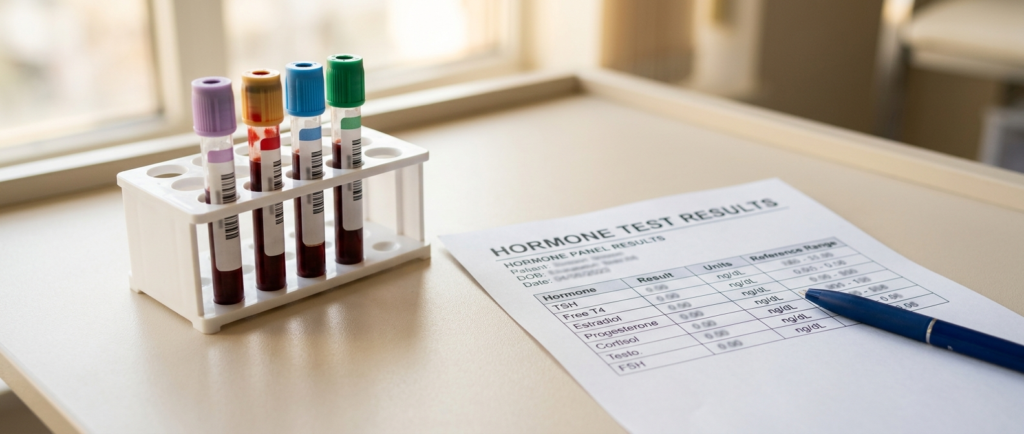
FSH, LH, oestradiol and thyroid function in one panel — for when your symptoms started early, don't fit the usual pattern, or you want an objective baseline. £114, reviewed by a doctor.
We'll be straight with you, because plenty of clinics aren't. National guidance is clear that if you are over 45 with typical menopausal symptoms, you do not need a blood test to be diagnosed — your symptoms are the diagnosis. If your GP has told you that, they are following the guidance correctly, and a test is unlikely to change your care.
Where testing genuinely earns its place is narrower, and specific. If you are under 45 and your periods have changed, hormone levels matter — early menopause and premature ovarian insufficiency are diagnosed partly on FSH, and they carry long-term bone and cardiovascular implications that make getting the answer worth it. The same applies if your symptoms don't fit the usual pattern, or if something else could explain them.
That last point is why this panel includes thyroid function. Fatigue, weight change, low mood, brain fog and irregular periods are the overlap between perimenopause and an underactive thyroid, and it is genuinely common to assume one when it is the other.
A straight answer, so you don't pay for a test that won't tell you anything new.
Follicle-stimulating hormone rises as the ovaries become less responsive. It is the single most informative marker for early menopause — though it fluctuates during perimenopause, so one reading is a data point rather than a verdict.
Luteinising hormone, read alongside FSH. The ratio between the two helps distinguish the menopausal transition from other causes of irregular cycles, such as PCOS.
The main form of oestrogen in your reproductive years. Falling levels drive most of the symptoms people recognise — hot flushes, night sweats, sleep disruption, vaginal dryness.
Included deliberately. An underactive thyroid produces fatigue, weight gain, low mood, brain fog and cycle changes — the same list. Testing both at once means you do not treat the wrong one.
Choose a 20-minute slot. If you are still having periods, day 2–5 of your cycle gives the most interpretable FSH result — tell us and we'll help you time it.
A trained phlebotomist takes the sample here in Bromley. No fasting needed — just come well hydrated, and bring a list of any hormonal medication you take.
Your sample is analysed by a laboratory, then a doctor reviews the panel as a whole and provides a comprehensive report, highlighting anything worth raising with your GP.
Sometimes. If you're under 45 it's genuinely informative. If you're over 45 with typical symptoms, national guidance says the diagnosis is made on symptoms alone and a test won't add much — we'd rather tell you that up front.
During perimenopause, FSH swings considerably from cycle to cycle — it can look menopausal one month and normal the next. Where the answer really matters, particularly under 40, it's usually repeated after four to six weeks.
You can, but combined hormonal contraception suppresses FSH and makes it unreliable for this purpose. Tell us what you're taking when you book and we'll advise whether the result will be worth having.
If you're still having periods, day 2–5 is the standard window and gives the most interpretable FSH and oestradiol results. If your periods have stopped or become unpredictable, any day is fine.
No — this is a testing service. Your results are reviewed by a doctor who provides a comprehensive report showing what is worth discussing with your GP, who can assess you fully and prescribe.
No. Just come well hydrated — it makes the blood draw quicker and more comfortable.
If you want to look at the thyroid overlap in more depth — free T3 and antibodies as well as TSH and free T4.
Our full menu of private blood panels, with prices — from cholesterol and HbA1c to the comprehensive Premier Health Profile.
Book a Menopause Hormone Profile at our Bromley pharmacy — £114, all in.